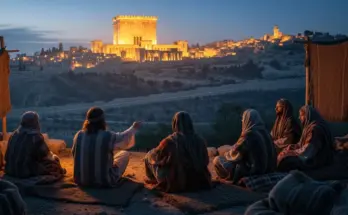
Joshua 24 stands as one of the most deliberate moments in Israel’s story. The land has been settled, major battles have ended, and leadership is about to change. This chapter gathers the people at Shechem, a place already rich with covenant memory, and presses a single question that cannot be avoided. Will Israel remain faithful to the LORD when conquest gives way to ordinary life?
The book context matters here. Throughout the Book of Joshua, God has shown Himself faithful to every promise made to Abraham, Isaac, and Jacob. He brought Israel into the land just as He said He would. Joshua 24 fits at the close of that story, serving as Joshua’s final public address and Israel’s formal re-commitment to the covenant.
This chapter matters because it removes the illusion of neutrality. Joshua does not allow Israel to drift quietly into the future. Instead, he calls them to choose faithfulness with clarity and intention. Joshua 24 shows how covenant loyalty must be renewed, remembered, and embraced by each generation. This outline will walk through the chapter’s flow, its historical grounding, and its place within the larger covenant story.
Joshua 24:1–13 — God Speaks First: Grace Before Command
“Joshua gathered all the tribes of Israel to Shechem and summoned the elders, the heads, the judges, and the officers of Israel, and they presented themselves before God. And Joshua said to all the people, ‘Thus says the LORD, the God of Israel, “Long ago, your fathers lived beyond the Euphrates, Terah, the father of Abraham and of Nahor; and they served other gods.’” (Joshua 24:1–2, ESV)
Joshua gathers Israel at Shechem, a place loaded with covenant memory. Abraham first built an altar there. Jacob buried foreign gods there. Now Israel stands again before the LORD.
Notice something important. Joshua does not begin by commanding obedience. He begins by recounting God’s actions. Even more striking, God Himself speaks in the first person through Joshua. This is not merely a historical review. It is divine testimony.
God reminds Israel that their story did not begin with faithfulness. It began with idolatry. Abraham’s family served other gods. This sets the tone for everything that follows. Israel exists because God intervened, not because their ancestors were better than others.
Joshua 24:3–5 (ESV)
“Then I took your father Abraham from beyond the River and led him through all the land of Canaan, and made his offspring many. I gave him Isaac. And to Isaac I gave Jacob and Esau. And I gave Esau the hill country of Seir to possess, but Jacob and his children went down to Egypt. And I sent Moses and Aaron, and I plagued Egypt with what I did in the midst of it, and afterward I brought you out.”
The repeated emphasis is impossible to miss. “I took… I led… I gave… I sent… I brought.” God is the subject of every verb. Israel’s history is framed as a work of divine initiative.
Even the mention of Esau receiving land reminds Israel that God is sovereign over all peoples, not only Israel. Yet Jacob’s line becomes the channel of promise. Their time in Egypt, though painful, was part of God’s unfolding plan.
Joshua 24:6–7 (ESV)
“Then I brought your fathers out of Egypt, and you came to the sea. And the Egyptians pursued your fathers with chariots and horsemen to the Red Sea. And when they cried to the LORD, he put darkness between you and the Egyptians and made the sea come upon them and cover them; and your eyes saw what I did in Egypt. And you lived in the wilderness a long time.”
God reminds them that deliverance came when they cried out, not when they had power. Israel saw with their own eyes what God did. The wilderness years are mentioned briefly, but meaningfully. God sustained them through a long season where trust was tested daily.
Joshua 24:8–10 (ESV)
“Then I brought you to the land of the Amorites, who lived on the other side of the Jordan. They fought with you, and I gave them into your hand, and you took possession of their land, and I destroyed them before you. Then Balak the son of Zippor, king of Moab, arose and fought against Israel. And he sent and invited Balaam the son of Beor to curse you, but I would not listen to Balaam. Indeed, he blessed you. So I delivered you out of his hand.”
Even unseen dangers are brought into the light. Israel may not have known every threat working against them, but God knew. Balaam’s story is a reminder that God protects His people even when they are unaware of the danger.
Joshua 24:11–13 (ESV)
“And you went over the Jordan and came to Jericho, and the leaders of Jericho fought against you, and also the Amorites, the Perizzites, the Canaanites, the Hittites, the Girgashites, the Hivites, and the Jebusites. And I gave them into your hand. And I sent the hornet before you, which drove them out before you, the two kings of the Amorites; it was not by your sword or by your bow. I gave you a land on which you had not labored and cities that you had not built, and you dwell in them. You eat the fruit of vineyards and olive orchards that you did not plant.”
This section closes with an unmistakable conclusion. Israel did not win by military strength. They inherited what they did not earn. God wants them to understand this before He asks anything of them.
Grace always comes first!
Joshua 24:14–24 — Choose Whom You Will Serve
“Now therefore fear the LORD and serve him in sincerity and in faithfulness. Put away the gods that your fathers served beyond the River and in Egypt, and serve the LORD. And if it is evil in your eyes to serve the LORD, choose this day whom you will serve, whether the gods your fathers served in the region beyond the River, or the gods of the Amorites in whose land you dwell. But as for me and my house, we will serve the LORD.” (Joshua 24:14–15, ESV)
The word “therefore” matters. Obedience flows from remembrance. Because God has acted faithfully, Israel must respond decisively.
Joshua does not allow neutrality. He presents a clear choice. The gods of the past or the LORD who redeemed them. Even living in the land brings temptation, because the culture around them worships other gods.
Joshua’s declaration is personal and public. He does not wait for consensus. He leads by example. Faithfulness begins at home.
Joshua 24:16–18 (ESV)
“Then the people answered, ‘Far be it from us that we should forsake the LORD to serve other gods, for it is the LORD our God who brought us and our fathers up from the land of Egypt, out of the house of slavery, and who did those great signs in our sight and preserved us in all the way that we went, and among all the peoples through whom we passed. And the LORD drove out before us all the peoples, the Amorites who lived in the land. Therefore we also will serve the LORD, for he is our God.’”
The people respond well. They echo the language of remembrance. They affirm that God alone deserves their loyalty. At this moment, their confession aligns with truth.
Yet Joshua knows something important. Words are easy. Covenants are not.
Joshua 24:19–20 (ESV)
“But Joshua said to the people, ‘You are not able to serve the LORD, for he is a holy God. He is a jealous God; he will not forgive your transgressions or your sins. If you forsake the LORD and serve foreign gods, then he will turn and do you harm and consume you, after having done you good.’”
This is one of the most sobering statements in the book. Joshua is not denying God’s mercy. He is warning against casual commitment. God’s holiness means covenant faithfulness matters.
Joshua wants them to understand the weight of what they are saying.
Joshua 24:21–24 (ESV)
“And the people said to Joshua, ‘No, but we will serve the LORD.’ Then Joshua said to the people, ‘You are witnesses against yourselves that you have chosen the LORD, to serve him.’ And they said, ‘We are witnesses.’ He said, ‘Then put away the foreign gods that are among you, and incline your heart to the LORD, the God of Israel.’ And the people said to Joshua, ‘The LORD our God we will serve, and his voice we will obey.’”
Commitment now moves from words to action. Joshua presses them to remove foreign gods. Loyalty to the LORD requires inward inclination, not only outward confession.
Joshua 24:25–28 — Covenant Confirmed and Witness Established
“So Joshua made a covenant with the people that day, and put in place statutes and rules for them at Shechem. And Joshua wrote these words in the Book of the Law of God. And he took a large stone and set it up there under the terebinth that was by the sanctuary of the LORD.” (Joshua 24:25–26, ESV)
This covenant renewal is formal. It is recorded. It is public. The stone stands as a witness, echoing earlier covenant moments in Israel’s history.
Joshua 24:27–28 (ESV)
“And Joshua said to all the people, ‘Behold, this stone shall be a witness against us, for it has heard all the words of the LORD that he spoke to us. Therefore it shall be a witness against you, lest you deal falsely with your God.’ So Joshua sent the people away, every man to his inheritance.”
The stone symbolizes accountability. Israel cannot later claim ignorance. They heard the words. They agreed to the covenant. They now return to daily life with that commitment resting upon them.
Joshua 24:29–33 — A Faithful Generation Passes
“After these things Joshua the son of Nun, the servant of the LORD, died, being 110 years old. And they buried him in his own inheritance at Timnath-serah, which is in the hill country of Ephraim, north of the mountain of Gaash.” (Joshua 24:29–30, ESV)
Joshua is remembered not primarily as a conqueror, but as the servant of the LORD. His life closes with faithfulness, not spectacle.
Joshua 24:31 (ESV)
“Israel served the LORD all the days of Joshua, and all the days of the elders who outlived Joshua and had known all the work that the LORD did for Israel.”
Faithfulness continued while memory remained strong. This verse quietly prepares us for what comes next in Israel’s story.
Joshua 24:32–33 (ESV)
“As for the bones of Joseph, which the people of Israel brought up from Egypt, they buried them at Shechem, in the piece of land that Jacob bought from the sons of Hamor the father of Shechem for a hundred pieces of money. It became an inheritance of the descendants of Joseph. Eleazar the son of Aaron died; and they buried him at Gibeah, the town of Phinehas his son, which had been given him in the hill country of Ephraim.”
Joseph’s burial completes a promise made centuries earlier. What God began in Genesis reaches fulfillment here. The deaths of Joshua, Joseph, and Eleazar mark the close of a chapter in redemptive history.
Closing Reflection
Joshua 24 draws Israel’s story to a careful and deliberate close. The chapter does not celebrate military success or national strength. Instead, it centers on covenant loyalty grounded in God’s proven faithfulness. By reviewing history, issuing a clear challenge, and renewing commitment, Joshua presses Israel to understand what life in the land truly requires.
Within the larger story of Scripture, Joshua 24 shows that God’s promises call for a faithful response. God fulfills His word with patience and power, yet He invites His people to walk with Him intentionally. This pattern continues throughout Scripture, pointing beyond land and nation to deeper covenant fulfillment.
When we read Joshua 24 in light of Christ, we see the same call clarified and completed. God’s faithfulness reaches its fullness through Jesus, who secures the covenant by His own obedience. Therefore, Joshua’s challenge still echoes, not as pressure, but as truth. Faithfulness flows from remembering who God is and trusting what He has already done.
Continue Exploring Chapter Outlines
This outline is part of our growing collection of Chapter Outlines. You can explore more Bible Outlines or return to the Bible Study Toolbox homepage for outlines, studies, and resources to deepen your understanding of God’s Word. Contact us anytime.