A Call That Cuts Against All Reason
The book opens with a prophet anchored in history, not myth. Hosea is introduced during the reigns of Uzziah, Jotham, Ahaz, and Hezekiah in Judah, and Jeroboam son of Joash in Israel (Hosea 1:1). This places his ministry in the eighth century BC, a period of outward prosperity in the northern kingdom and deep spiritual collapse beneath the surface. Israel’s borders were secure and its economy strong under Jeroboam II, yet covenant faithfulness had eroded. Baal worship flourished alongside the LORD’s name. Political confidence masked moral decay.
Into that setting, the word of the LORD comes with a command that does not resemble anything expected of a prophet. Hosea is told to marry “a wife of whoredom” and have children with her, because the land itself is guilty of great unfaithfulness to the LORD (Hosea 1:2, ESV). The text offers no dramatic buildup, no recorded protest, no justification. The command stands stark and unsettling. It is not framed as a metaphor but as an action to be lived.
In the world of ancient Israel, a prophet’s credibility was bound tightly to his moral standing. Prophets were expected to model covenant loyalty, not embody its violation. Marriage itself was a public, communal matter, not a private arrangement. To marry a woman identified with sexual unfaithfulness would have invited social disgrace, suspicion, and ridicule. Hosea’s obedience therefore places him at odds not only with personal expectations but with communal norms. His life becomes the message before he ever speaks a word.
The language of Hosea 1:2 reflects covenant vocabulary. Israel is described as committing “whoredom” against the LORD, a term repeatedly used in Scripture to describe idolatry rather than mere moral failure. The marriage command functions as a prophetic sign-act, a visible action meant to communicate divine truth. Other prophets would later perform similar enacted messages, but Hosea’s is uniquely intimate and prolonged. This is not a momentary gesture. It is a life shaped by obedience.
Hosea’s response is recorded without commentary. “So he went and took Gomer, the daughter of Diblaim” (Hosea 1:3). The brevity of the statement is striking. Scripture does not speculate about his emotions, yet the weight of the act is unmistakable. Obedience here is not abstract faithfulness but costly submission. Hosea steps into a calling that will wound him personally while revealing the heart of God publicly.
From the beginning, the consequences are clear. Hosea’s household will be watched. His marriage will be interpreted. His faithfulness will be tested not in isolation but in full view of a resistant people. The setup of the book makes one truth unavoidable. God is not asking His prophet to explain Israel’s unfaithfulness from a distance. He is asking him to carry it, to live inside it, and to bear witness to a love that refuses to remain theoretical.
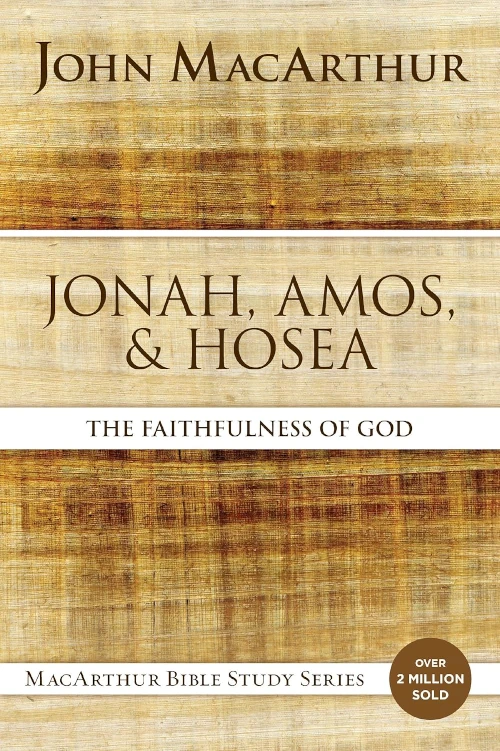
Jonah, Amos, and Hosea: The Faithfulness of God
God’s faithfulness is on display throughout Scripture but is especially evident in the books of Jonah, Amos, and Hosea.
Through the lives, examples, and messages of these three prophets, we see God’s constant love and forgiveness for Jews and Gentiles alike in spite of blatant disobedience, spiritual adultery, inappropriate worship, and a lack of justice.
Hosea: Love Tested by Repeated Betrayal
The conflict unfolds quietly but relentlessly, rooted in lived experience rather than dramatic proclamation. Hosea’s marriage, entered in obedience, becomes the arena where Israel’s unfaithfulness is no longer abstract. The text records that Gomer bears children, yet the narrative tension deepens as the LORD directs Hosea to give them names that function as prophetic judgments. Each name signals fracture rather than joy, reflecting a covenant relationship under strain rather than blessing freely received.
The birth of the first child, Jezreel, invokes a place of bloodshed and broken kingship. The name recalls the violence associated with the house of Jehu and signals that the northern kingdom’s apparent strength is nearing its end. The second child is named Lo-ruhamah, meaning “No Mercy,” declaring that compassion will no longer shield Israel from the consequences of persistent rebellion. The third is called Lo-ammi, “Not My People,” a name that strikes at the heart of covenant identity. These are not private family choices. They are public declarations. Hosea’s household becomes a visible ledger of divine grievance.
As the narrative progresses, the unfaithfulness hinted at in the opening command becomes unmistakable. Hosea speaks of his wife pursuing lovers and attributing her provision to them rather than to her husband. Scripture presents this behavior as parallel to Israel’s devotion to other gods, crediting Baal for grain, wine, and oil that the LORD alone had provided. The betrayal is not momentary. It is repeated, deliberate, and defended by self-deception.
Culturally, this imagery would have been devastatingly clear. In the ancient Near East, fertility gods were believed to control agricultural success. Israel’s participation in Baal worship was not merely theological error. It was a practical expression of misplaced trust. Hosea’s marriage mirrors this pattern. Love is offered within covenant, yet loyalty is given elsewhere. Provision is received, but gratitude is misdirected.
The emotional cost is implied rather than described. Hosea continues to speak as one bound by covenant while being treated as expendable. His language reflects grief and restraint rather than rage. He names the betrayal without embellishment and exposes its futility without denying its pain. This restraint itself communicates something essential about the heart of God. Judgment is pronounced, but it is not detached. It is spoken by One who has been wronged.
Scholarly discussion varies on whether Gomer’s unfaithfulness was ongoing from the beginning or whether it unfolded over time. The text does not resolve this explicitly. What remains clear is the pattern of betrayal and the prophet’s continued identification with a broken covenant. Hosea does not exit the relationship when trust is violated. He remains present as the consequences of unfaithfulness accumulate.
The conflict, then, is not merely marital. It is theological and national. Hosea’s personal suffering exposes the depth of Israel’s spiritual disorder. Love is offered again and again, yet rejected. Covenant remains in place, yet ignored. The prophet stands as both participant and witness, carrying in his own life the ache of a God whose people continue to stray while insisting they are still secure.
Hosea: Love That Pursues the Unlovely
The turning point arrives without spectacle, yet it carries the greatest emotional and theological weight of the book. After betrayal has run its course and separation has done its damage, the word of the LORD comes again to Hosea. This time the command does not expose unfaithfulness. It confronts the cost of mercy. Hosea is told to go once more and love a woman who is loved by another and is an adulteress, just as the LORD loves the people of Israel, though they turn to other gods (Hosea 3:1).
The instruction leaves no room for sentimentality. Love here is not grounded in reform, apology, or demonstrated faithfulness. It is commanded in the presence of ongoing disloyalty. Hosea is not asked to ignore sin or pretend betrayal did not occur. He is asked to act in a way that reveals the depth of covenant love despite it.
The narrative shifts from accusation to action. Hosea purchases the woman for fifteen shekels of silver and a measure and a half of barley (Hosea 3:2). The details matter. This is the language of redemption, not romance. The price suggests economic vulnerability and social degradation, possibly indicating debt servitude or a loss of protection. Scripture does not specify the setting, and responsible interpretation does not fill in gaps with certainty. What is clear is that restoration comes at real cost to the one who redeems.
In the ancient world, redemption implied both rescue and restraint. Hosea tells her she must remain with him for many days, abstaining from other relationships, while he does the same. This period is not punitive. It is stabilizing. Trust is not assumed. Covenant is reestablished deliberately, not impulsively. The relationship is neither erased nor rushed. Love pursues, but it also orders.
The personal action of the prophet widens immediately into national meaning. Hosea explains that Israel too will remain without king, prince, sacrifice, or idol for many days before returning to seek the LORD and His goodness (Hosea 3:4–5). The pattern is unmistakable. Loss precedes restoration. Absence prepares the way for renewal. Covenant love does not bypass discipline. It works through it.
This moment reshapes the entire narrative. Judgment has not been withdrawn, but it is no longer the final word. The God who names betrayal also initiates redemption. The wounded husband becomes the willing redeemer. Hosea’s obedience now reveals something Israel could not yet see. Divine love is not reactive. It is intentional. It moves toward the unfaithful, not away from them.
Scholars differ on how closely Hosea’s personal actions align chronologically with Israel’s historical decline. These discussions are interpretive and should be labeled as such. What the text itself makes plain is theological, not speculative. The turning point is not Israel’s repentance. It is God’s decision to pursue despite resistance.
Love here is neither indulgent nor weak. It names sin, absorbs cost, and creates space for transformation. Hosea’s act of redemption stands at the center of the book as lived theology. It shows that covenant faithfulness is not measured by the worthiness of the beloved, but by the steadfast character of the One who loves.
Hosea: Judgment Tempered by Relentless Mercy
The resolution does not erase judgment. It reframes it. As the message of Hosea widens beyond his household, the book presents a sustained indictment of Israel’s covenant violations. Idolatry, political alliances, social injustice, and ritual hypocrisy are named without hesitation. The consequences are equally clear. Assyria will rise. The northern kingdom will fall. Exile will strip away kings, altars, and false securities. These outcomes are not hypothetical warnings. They are the logical end of persistent rebellion against the LORD who brought Israel out of Egypt.
Yet judgment never stands alone in Hosea’s prophecy. Again and again, it is interrupted by divine resolve that refuses abandonment. God speaks of Israel as a child taught to walk, as a son called out of Egypt, as a beloved who has forgotten the source of life itself. The language is relational, not legalistic. Discipline is necessary, but it is not the goal. Restoration remains in view even when repentance is absent.
This tension reaches its clearest expression when the LORD declares His own inner conflict. He asks how He can give Israel up, how He can hand them over completely. The answer does not come from Israel’s change of heart, but from God’s own character. Compassion grows warm within Him. Mercy restrains total destruction. Judgment is real, but it is bounded by covenant love that God refuses to revoke.
Geographically and historically, the prophecy points toward the impending Assyrian conquest of Samaria in 722 BC. Hosea’s warnings align with what history confirms. The northern kingdom will cease to exist as a political entity. Yet Hosea’s vision extends beyond that collapse. He speaks of a future return, a healing after discipline, a people restored not by power but by renewed devotion. Israel will once again seek the LORD and David their king, a statement that looks beyond Hosea’s immediate context and gestures toward a re-centered covenant identity.
Scholars debate the precise scope of these restoration promises. Some interpret them as national renewal after exile. Others see theological trajectories that extend further into redemptive history. These discussions are interpretive and should be labeled as such. What the text itself affirms is unmistakable. God’s mercy is not sentimental. It does not cancel justice. It outlasts it.
The resolution, then, is not a reversal of consequences but a revelation of purpose. Judgment exposes the seriousness of covenant betrayal. Mercy reveals the unyielding commitment of the LORD to His people. Hosea’s life, his marriage, and his obedience converge here. The prophet who embodied Israel’s pain also embodied God’s persistence.
The story closes this section with hope that is neither rushed nor naive. Love has been wounded. Trust has been broken. Yet the covenant stands because it rests not on Israel’s consistency, but on God’s faithfulness. Judgment speaks truth. Mercy speaks last.
In Closing: When Obedience Hurts but Still Speaks
The story of Hosea does not resolve with personal vindication or visible success. Scripture records no moment where his obedience is applauded, no scene where the nation repents because of his faithfulness. What remains instead is a life that continues to testify long after the events themselves pass. Hosea’s obedience speaks not because it is triumphant, but because it is true.
Throughout the book, Hosea is shown acting in alignment with the word of the LORD even when that alignment brings loss rather than relief. He names Israel’s sin without softening it. He lives inside the consequences of covenant betrayal without abandoning the covenant. His actions reveal a God who does not confuse love with tolerance, nor justice with rejection. The prophet’s suffering is never presented as redemptive in itself, yet it becomes revelatory. Through Hosea, Israel is forced to see what their unfaithfulness costs the One who loves them.
Culturally, this message cut against every expectation of power and religion in the ancient Near East. Gods were assumed to abandon failed peoples. Covenants were broken when benefits ceased. Hosea proclaims something radically different. The LORD disciplines because He loves, and He restores because He remains faithful to His own name. This is not abstract theology. It is embodied truth, lived out in a household marked by pain, patience, and persistence.
The book closes without detailing Hosea’s later years. Scripture does not tell us how his story ended, and it does not need to. His obedience had already spoken clearly. Israel would fall, just as he warned. Mercy would endure, just as he lived. The prophet’s life stands as a witness that faithfulness is not measured by comfort, clarity, or immediate results, but by trust in the character of God when obedience wounds.
Hosea leaves readers with a quiet but unsettling question that lingers beyond his time. What does faithfulness look like when obedience costs more than it gives, and when love must be lived before it is understood?
Discover More Overlooked Bible Stories
We hope this untold story helps you see God’s work in a new way. You can keep exploring by visiting our homepage at BibleStudyToolbox.com. You can also browse more articles in the Overlooked Bible Stories category to continue your study. If you have any questions or want to reach out, please visit our Contact Page.