The book of Jude stands as a brief but thunderous letter near the very end of the New Testament. We find it tucked away just before the book of Revelation. This placement is no accident in the biblical story line. As the apostolic age began to draw to a close, the early church faced a shift in its primary struggle. While earlier books often addressed external persecution from the Roman Empire, Jude turns our eyes toward an internal threat. He writes to a community of believers that is being quietly infiltrated by deceptive teachers. These individuals claimed to belong to the church, yet their lives and doctrines denied the lordship of Jesus Christ.
We see the spiritual condition of God’s people as one of transition and vulnerability. The initial fire of the Pentecost generation was meeting the cold reality of false teaching. This creates the central tension of the book. Jude intended to write a peaceful letter about our shared salvation. However, the Holy Spirit compelled him to change his course. He felt an urgent necessity to warn the church about “crept in” intruders. The tone of the book is intensely urgent and remarkably stern. It carries the weight of a spiritual battlefield briefing.
Writer of the book of Jude
The writer identifies himself simply as Jude, a servant of Jesus Christ and a brother of James. Most scholars and ancient traditions credit this letter to Jude, the half-brother of Jesus. We see this confirmed by his self-identification as the brother of James, who was the prominent leader of the Jerusalem church. It is a mark of profound humility that Jude does not claim biological kinship with the Lord as a badge of authority. Instead, he chooses the title of “servant” or “slave.” This choice reflects a deep theological shift in his life. Before the resurrection, the brothers of Jesus did not believe in Him. After witnessing the risen Christ, Jude’s entire identity was redefined by grace.
Jude’s background was likely that of a Palestinian Jew who grew up in the same household as the Savior. We can imagine his life was shaped by the daily rhythms of Jewish law and the specific expectations of the Messianic hope. His writing reveals a man deeply steeped in Old Testament history and Jewish tradition. He speaks with the authority of someone who has seen the gospel transform his own family and his own heart.
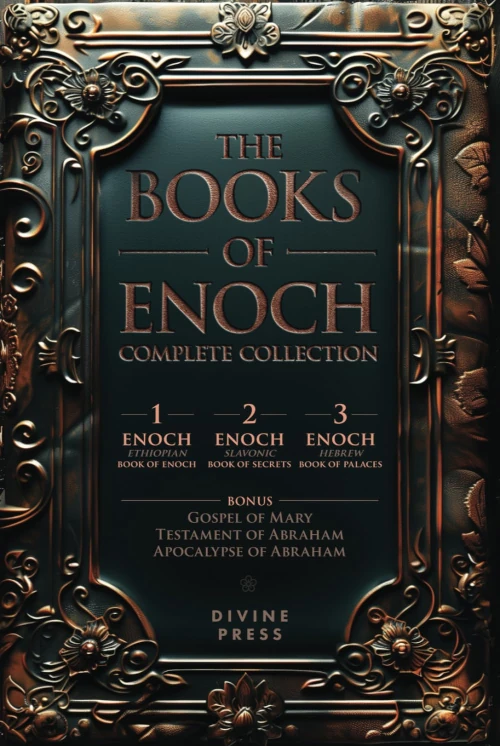
The Books of Enoch: Complete Collection – Featuring 1 Enoch, 2 Enoch, 3 Enoch, Original Illustrations & Bonus Apocryphal Texts
This complete collection brings together the most significant writings attributed to Enoch, offering an in-depth look at his visions and teachings. Each book takes you on a journey through ancient wisdom, revealing the mysteries of the heavens and the divine knowledge passed down through generations.
Date Written
Establishing the date for the book of Jude requires us to look at the internal clues regarding the state of the church. Most conservative scholars place the writing between AD 65 and AD 80. We know it must have been written while some of the apostles were still alive or their teachings were very fresh in the minds of the people. Jude refers to the “predictions of the apostles of our Lord Jesus Christ,” suggesting that the foundational apostolic era was either ending or had recently concluded. This timing is crucial because it shows the church was entering its second generation.
The letter was likely written after the major epistles of Paul but before the final writings of John. Some note the striking similarities between Jude and 2 Peter. If Jude used Peter’s letter as a resource, or vice versa, it places the writing in the mid-to-late 60s. During this period, the political climate was increasingly hostile toward Christians under the reign of Emperor Nero. However, the primary focus of Jude is not political. He focuses on the spiritual corruption that often follows a period of rapid growth.
To Whom Written
The book of Jude is a general epistle, meaning it was likely intended for a broad circle of churches rather than one specific city. We see from his language that the primary audience was likely composed of Jewish Christians. Jude assumes his readers have a deep knowledge of the Old Testament. He references obscure events like the dispute over the body of Moses and the prophecy of Enoch without feeling the need to explain them. This suggests a high level of spiritual literacy among the recipients.
Despite their knowledge, the audience was in a state of spiritual danger. They were being influenced by “ungodly people who pervert the grace of our God into sensuality.” These readers were struggling to distinguish between true Christian liberty and sinful license. The cultural background of the audience involved living in a Greco-Roman world where sexual immorality was often tied to religious practice. This made the false teachers’ message of “grace without holiness” very tempting to those coming out of paganism or struggling with legalism.
Their situation shapes the sharp, confrontational tone of the letter. Jude does not offer the same long, warm greetings found in Paul’s letters to his friends. Instead, he addresses them as those who are “called, beloved in God the Father and kept for Jesus Christ.” He wants them to remember their secure identity so they will not be swayed by the chaos around them. He treats them as soldiers who have forgotten they are in a war. He writes to wake them up to the reality that their spiritual house is being robbed from the inside.
Purpose of the Book of Jude
The main reason the book of Jude was written is clearly stated in the third verse of the letter. Jude writes:
"Beloved, although I was very eager to write to you about our common salvation, I found it necessary to write appealing to you to contend for the faith that was once for all delivered to the saints." (Jude 3, ESV)
We see here that his original intent was a celebratory instruction on the gospel. However, the emergence of false teachers forced him to pivot to a defensive posture. The book addresses the specific misunderstanding that the grace of God acts as a “license” to sin. It seeks to warn the church that God’s judgment is certain for those who lead His people astray.
Jude expects a very specific response from his audience. He does not want them to merely be aware of the problem. He wants them to “contend.” This word implies an intense struggle or an athletic competition. He calls them to build themselves up in their most holy faith and to pray in the Holy Spirit. He also expects them to show mercy to those who are wavering under the influence of the false teachers.
The purpose of the book is to preserve the integrity of the gospel message. If the false teachers were allowed to continue, the very definition of “Christian” would have been lost to immorality. Jude writes to ensure that the “faith once for all delivered” remains pure for every generation that follows. He wants the church to understand that defending the truth is a necessary act of love for God and for the neighbor.
Historical Context of the Book of Jude
The historical context of the book of Jude is defined by the tension between the dying Roman Republic and the burgeoning Christian movement. During the late first century, the Roman Empire provided a level of stability through the Pax Romana. This allowed for the travel and communication necessary to spread the gospel. However, this same environment promoted a “pluralistic” religious climate. People were encouraged to syncretize different beliefs. The culture valued new ideas and philosophical debates, which often led to the corruption of the exclusive claims of Christ.
We see that the religious climate was also influenced by a Jewish community in the diaspora. Many Jews were scattered throughout the empire, maintaining their synagogues but often clashing with the new “Way” of Jesus. Meanwhile, early forms of Gnosticism began to whisper that the physical world was evil and only the “spirit” mattered. This led to a dangerous practice called antinomianism, which literally means “against law.” These people believed that because they were saved by grace, it did not matter what they did with their physical bodies.
Key Themes in the Book of Jude
One of the most prominent themes in the book of Jude is the certainty of divine judgment. Jude uses a rapid-fire series of historical examples to show that God does not overlook rebellion. He mentions the Israelites in the wilderness, the fallen angels, and the cities of Sodom and Gomorrah. These repeated references serve as a sober warning. We are taught that God is a Judge who protects the holiness of His kingdom. This theme is balanced by the theme of God’s preserving power. Despite the danger, Jude emphasizes that God is “able to keep you from stumbling.”
The doctrine of the “faith once for all delivered” is another central theme. This highlights the finality of the gospel. We are taught that the message of Jesus is not something humans can edit or update for modern tastes. It is a finished deposit that must be guarded. Related to this is the theme of apostasy. Jude describes people who have tasted the truth but have turned away to follow their own ungodly desires. He uses vivid natural metaphors to describe them, such as “clouds without water” and “fruitless trees.“
We also see a strong emphasis on the human response of “contending.” Faith is not described as a passive state but as an active defense of the truth. Finally, the theme of mercy shines through in the closing verses. Even in a book about judgment, we are told to “have mercy on those who doubt.” This shows that the goal of the letter is restoration, not just condemnation. The attribute of God most highlighted is His sovereignty. He is the one who reigns over history, angels, and the final destiny of all humanity.

Major Events and Stories in the Book of Jude
Since Jude is a short epistle, it does not contain a narrative plot with characters moving through time. Instead, it features a “parade” of major biblical events used as theological evidence. The first turning point in his argument is the reminder of the Exodus. He writes:
"Now I want to remind you, although you once fully knew it, that Jesus, who saved a people out of the land of Egypt, afterward destroyed those who did not believe." (Jude 5, ESV)
This is a supernatural moment of judgment that sets the stage for his entire warning. He then moves to the cosmic realm, mentioning the judgment of angels who left their proper dwelling. This expands the message beyond the human scale to show that no created being is above God’s law.
A very unique “story” Jude includes is the account of Michael the archangel. He describes a moment where Michael contended with the devil over the body of Moses. While this event is not found in the Old Testament, Jude uses it to illustrate a major point about humility and authority. Even a powerful archangel did not pronounce a blasphemous judgment but said, “The Lord rebuke you.” This moves the message forward by contrasting the arrogance of the false teachers with the humility of God’s holy angels.
The final “event” in the book is the prophecy of Enoch. Jude quotes a tradition that Enoch, the seventh from Adam, prophesied about the Lord coming with ten thousands of His holy ones to execute judgment. This serves as a prophetic climax. It connects the earliest days of humanity to the final return of Christ. Each of these references acts as a building block. They convince the reader that the current crisis of false teaching is just another chapter in an ancient war between truth and falsehood.
Theological Contributions in the Book of Jude
The book of Jude makes unique contributions to our understanding of God and the spiritual world. One of its most striking insights is the way it attributes Old Testament actions to Jesus. By saying “Jesus… saved a people out of the land of Egypt,” Jude makes a bold statement about the pre-existence of Christ. He teaches us that the Jesus Christ has always been the Deliverer and Judge of His people. This strengthens our understanding of the unity of the Bible and the central role of Christ in all of history.
Regarding humanity, Jude reveals the depth of our capacity for deception. He shows that it is possible to be “hidden reefs” at a church fellowship meal. This teaches us that true faith is not merely about being in the right place or saying the right words. It reveals that the heart of human sin is often found in the rejection of authority. These false teachers “abandoned” their proper place, just as the fallen angels did. Jude contributes to covenant theology by showing that being part of the “visible” covenant community (like the Israelites in the desert) does not guarantee salvation if there is no genuine faith.
The book also provides a unique look into “angelology,” the study of angels. It gives us glimpses into a spiritual realm where intense battles are fought over things as specific as the body of a prophet. Most importantly, Jude contributes to our “doxology“—the way we praise God. His concluding verses are some of the most beautiful in Scripture:
"Now to him who is able to keep you from stumbling and to present you blameless before the presence of his glory with great joy, to the only God, our Savior, through Jesus Christ our Lord, be glory, majesty, dominion, and authority, before all time and now and forever. Amen." (Jude 24–25, ESV)
This reveals that while we are called to contend, it is ultimately God who secures our victory.
Special Considerations in the Book of Jude
There are several special considerations and interpretive challenges within the book of Jude. Perhaps the most famous is his use of non-canonical sources, such as the Assumption of Moses and the Book of Enoch. Some modern readers find it confusing that a biblical writer would quote books that are not in our Bibles. However, we should understand that Jude was not necessarily saying these entire books were inspired by God. Instead, he was quoting true statements found within them to make a point, much like Paul quoted Greek poets. We must avoid the misunderstanding that this makes the Book of Enoch equal to Scripture.
Another challenge is the vivid, figurative language. Jude calls the false teachers “waterless clouds, swept along by winds; fruitless trees in late autumn, twice dead, uprooted; wild waves of the sea, casting up the foam of their own shame.” These are not just insults. They are precise theological descriptions. They describe things that look promising from a distance but provide no life-giving substance. Understanding the Mediterranean climate, where rain is life, helps us feel the weight of a “waterless cloud.” It is a picture of profound disappointment and spiritual emptiness.
We should also be careful with the eschatological implications of the book. Jude sees his current day as being the “last time.” For two thousand years, the church has lived in this “last time.” This teaches us that the return of Christ is always “at hand” and should always motivate our holiness. A common misunderstanding to avoid is thinking that “contending for the faith” means being mean-spirited or argumentative. Jude’s call to contend is rooted in a desire to save others “by snatching them out of the fire.” It is a rescue mission, not a personal vendetta.
CLosing Reflection on the Book of Jude
The final message of the book of Jude is one of extreme vigilance paired with extreme confidence. The book resolves its main tension—the threat of false teachers—not by offering a new program or a political solution, but by pointing believers back to the foundation. We are told to remember the words of the apostles and to keep ourselves in the love of God. The lasting spiritual takeaway is that the purity of the church is worth fighting for. Truth matters because it is the only thing that can truly set people free.
For believers today, Jude is a call to discernment. We live in an age where “my truth” is often valued over “the truth.” Jude reminds us that the faith has been “once for all delivered.” We do not have the right to change the gospel to make it more popular. Practically, this means we must be students of the Word so we can recognize the “hidden reefs” in our own culture. We apply this book by building up our local churches, praying deeply, and looking for the mercy of our Lord Jesus Christ.
Discover More in Bible Study Toolbox
Looking for more? Explore additional New Testament Bible Outlines to see how God’s Word fits together chapter by chapter. Each outline is part of the resources available at Bible Study Toolbox, where we provide studies, guides, and tools to help believers grow in the Word with clarity and confidence. Contact us with any questions or concerns.