Death Row at Golgotha
Golgotha lies just outside Jerusalem’s walls, a place chosen for visibility and warning. The Gospels describe it as the site where Rome carried out public executions, ensuring that death itself became a lesson. Jesus is led there bearing His cross, surrounded by soldiers and watched by crowds drawn by Passover activity. Alongside Him are two criminals, men condemned under Roman law, their guilt assumed and their fate sealed. While history remembers the thief on the cross as a figure of desperate redemption, scripture offers no biographical details about these men; yet, their placement beside Jesus is deliberate and telling.
All four Gospel writers agree on the central fact: Jesus is crucified between two lawbreakers. Luke notes that they are “criminals,” a term often associated with violent offenders or rebels rather than petty thieves. This matters because crucifixion was not a punishment for minor crimes. It was reserved for those Rome viewed as threats to order. The method was designed to prolong suffering and erase dignity. Victims were stripped, nailed or tied to wood, and left exposed until death came by exhaustion or suffocation. The consequence was unavoidable and final.
The scene unfolds during Passover, when Jerusalem swells with pilgrims remembering Israel’s deliverance from slavery. The irony is sharp. A Roman governor has authorized the execution of a man declared innocent, while two guilty men suffer beside Him. From a human standpoint, judgment appears clear. Rome has spoken. The crosses stand as verdicts already rendered.
Yet Scripture subtly reframes the moment. One criminal will later acknowledge that their punishment is deserved, indicating an internal recognition of guilt even before any words are recorded. Their presence beside Jesus fulfills Isaiah’s words that the Servant would be “numbered with the transgressors” (Isaiah 53:12, ESV). This is not incidental geography. It is theological placement. Jesus is physically located among the guilty, sharing their fate though not their sin.
No appeals remain. No reversals are expected. The crowd mocks, soldiers cast lots, and death advances steadily. Golgotha becomes a threshold where justice, guilt, and divine purpose converge. What looks like the end of the story is, in fact, the setting for a final and decisive revelation of the heart.
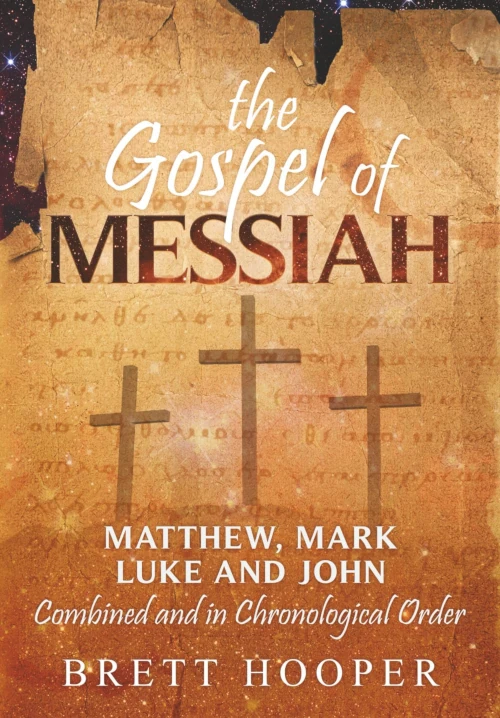
The Gospel of Messiah: Matthew, Mark, Luke, and John combined
Discover the Life of Jesus—Clear, Complete, Chronological
Do you find the Gospels confusing or fragmented? The Gospel of Messiah offers a clear and captivating experience by combining the Gospels in chronological order into one easy-to-read text. Whether you’re a believer seeking deeper understanding, an agnostic exploring the truth, or simply curious about Jesus…
Shared Guilt, Divergent Hearts
As the hours pass, the suffering deepens and voices rise from the crosses. Luke records that one of the criminals joins the chorus of mockery aimed at Jesus. His words echo the crowd and the rulers below, demanding proof of power and relief from pain. The request is not for mercy, but for escape. If Jesus truly is the Christ, he reasons, deliver yourself and us. In this moment, guilt is not denied, but it is weaponized. Judgment becomes something to deflect rather than face.
The other criminal responds differently. He rebukes his companion, not out of moral superiority, but from clarity. He acknowledges that they are receiving the due reward for their deeds, while Jesus has done nothing wrong. This admission matters. Roman crucifixion allowed no formal confession process, yet here, suspended between life and death, one man names the truth of his condition. His words reveal an internal reckoning. Guilt is accepted rather than resisted. Justice is affirmed rather than challenged.
This exchange exposes a deeper conflict than physical agony. Both men endure the same punishment, under the same sky, beside the same crucified Messiah. Yet their hearts move in opposite directions. One demands deliverance without repentance. The other submits to judgment while recognizing innocence in the man beside him. The contrast is stark. Suffering does not soften both hearts equally. It reveals what already lies within.
Theologically, this moment underscores a consistent biblical pattern. Exposure to truth produces either resistance or humility. The presence of Jesus intensifies that divide. Even in His apparent weakness, He provokes decisions. According to Luke’s account, the repentant criminal’s defense of Jesus is public and costly. It separates him from the crowd’s consensus and from his fellow condemned man. The consequence is isolation, yet also clarity.
Some scholars note that Luke emphasizes moral reversal throughout his Gospel, highlighting unexpected responses to Jesus from outsiders and sinners. This scene fits that pattern. A man judged by Rome and society recognizes righteousness where religious leaders have not. While interpretations vary on the criminal’s full understanding, the text is clear on the central tension. Shared guilt does not produce shared repentance. The conflict is not about proximity to Jesus, but posture toward Him.
A Kingdom Recognized in Ruin
At the center of the scene stands a moment that defies every visible reality. The condemned man who has acknowledged his guilt now turns his attention fully toward Jesus Christ. Luke records his appeal with careful restraint, preserving its simplicity and weight. He asks to be remembered when Jesus comes into His kingdom. Nothing in the setting supports such a request. There is no crown, no army, no sign of triumph. Jesus is dying under a Roman sentence, publicly marked as defeated.
Yet this is precisely what makes the moment decisive. The criminal recognizes a kingdom where none appears to exist. In Jewish expectation, the kingdom of God was associated with restoration, justice, and divine rule. Many anticipated a visible overthrow of oppressors. What this man perceives instead is authority that survives apparent ruin. His words acknowledge not only Jesus’ future vindication, but His rightful kingship beyond death itself.
The request is striking for what it does not include. He asks for remembrance, not rescue. He does not challenge the justice of his sentence or seek relief from suffering. His motivation appears grounded in trust rather than desperation. He entrusts his fate to Jesus at a moment when faith offers no earthly benefit. The consequence of that choice is immediate vulnerability. He publicly aligns himself with a condemned man whom the crowd has rejected and the authorities have silenced.
This turning point carries deep theological weight. Faith is expressed without time for restitution, ritual, or demonstration. According to Luke’s Gospel, this recognition occurs before the resurrection, when understanding of Jesus’ mission remains partial even among His followers. Some scholars suggest the man’s statement reflects a belief in final judgment and vindication rather than a fully formed resurrection theology. That interpretation highlights the nature of his faith. It rests not on full comprehension, but on recognition of who Jesus is.
No apocryphal or extra-biblical sources add reliable detail here, and Scripture offers no further clarification about the man’s background or beliefs. The restraint of the text sharpens its impact. In the collapse of earthly power and the silence of death, a kingdom is acknowledged. The ruin surrounding the cross becomes the very place where faith sees most clearly.
Paradise Spoken into the Present
The answer comes from the center cross, brief and unambiguous. Jesus Christ responds to the condemned man’s request not with postponement, but with assurance. Luke records that Jesus promises him presence with Him in paradise, and He anchors that promise in the immediacy of “today.” The weight of the moment lies not in elaboration, but in certainty. Death remains unavoidable, yet its meaning is fundamentally altered.
This response does not overturn justice as Rome understands it. The man will still die under sentence. His body will still bear the cost of his crimes. What changes is not the execution, but the verdict beyond it. Jesus does not deny the man’s guilt. He has already acknowledged it himself. Instead, Jesus addresses the deeper judgment, the final separation from God that guilt rightly deserves. The promise of paradise reframes the outcome without minimizing the seriousness of sin.
The term “paradise” carries rich biblical resonance. In Jewish thought, it was associated with a place of blessed rest and divine presence, often connected to the righteous dead awaiting final restoration. Some scholars equate it with what later Jewish literature called “the garden,” echoing Eden’s imagery of restored fellowship. Others understand it as a temporary state of comfort prior to resurrection. While interpretations differ, the core meaning in Luke’s account is clear. The man is promised immediate communion with Jesus after death, not abandonment or delay.
The consequence of this promise is profound. A man publicly executed as a criminal receives assurance reserved for the faithful. The timing matters. Jesus speaks these words while still suffering, before vindication, before resurrection. He exercises authority even as His life ebbs away. This underscores a central truth of the Gospel narrative. Jesus’ kingship is not postponed until after the cross. It is revealed through it.
No extra-biblical sources expand on this exchange, and Scripture offers no further commentary from the crowd or the other criminal. The silence itself is instructive. The promise stands uncontested, spoken into the present tense of pain and finality. Paradise is not framed as escape from death, but as transformed destiny through faith. In that moment, judgment is not erased, but fulfilled, and mercy is spoken with absolute clarity.

Bible Verse Wall Stickers Inspirational Quote Wall Decals
You will receive 4 sheets of bible verse wall stickers, printed with 7 different inspirational quotes, adding a motivational atmosphere to your home, various to decorate the corners of your home, making your home beautiful and delicate
Faith at the Last Possible Moment
As the scene at Golgotha draws toward silence, the story leaves one final, unsettling clarity. A man with no remaining future makes a choice that defines his eternity. He does not descend from the cross. He does not undo his crimes. He does not restore what he has broken. What he does is entrust himself, fully and finally, to Jesus Christ. Scripture presents this not as a loophole in justice, but as a revelation of how faith meets mercy at the edge of judgment.
The Gospel writers offer no sentimental framing. The man’s suffering remains real. His death remains imminent. Yet his faith stands in stark contrast to the rulers, soldiers, and even one fellow criminal who reject Jesus while demanding proof on their own terms. The consequence of his choice is not survival, but assurance. His story ends not with rescue from death, but with promise beyond it.
This moment has often drawn theological reflection. Some traditions emphasize it as evidence that salvation rests on faith rather than accumulated works. Others stress its uniqueness, noting that it occurs before the resurrection, in a transitional moment of redemptive history. These discussions, while important, do not dilute the narrative force of the text. Luke’s account presents a man who believes when belief offers no visible advantage. His faith is not a strategy. It is surrender.
The cultural and legal finality of crucifixion sharpens the weight of the scene. Roman executions allowed no reversals. Public shame sealed a person’s legacy. Yet Scripture records that legacy differently. This man is remembered not for his crimes, but for his recognition of truth at the last possible moment. His story stands as a quiet testimony that faith is not measured by duration, but by direction.
The cross does not eliminate judgment. It clarifies it. Guilt is acknowledged. Justice is not denied. Still, mercy speaks. The question the passage leaves behind is unavoidable. When nothing remains to offer but trust, where do our hearts turn, and whom do we believe has the final word?
Discover More Overlooked Bible Stories
We hope this untold story helps you see God’s work in a new way. You can keep exploring by visiting our homepage at BibleStudyToolbox.com. You can also browse more articles in the Overlooked Bible Stories category to continue your study. If you have any questions or want to reach out, please visit our Contact Page.