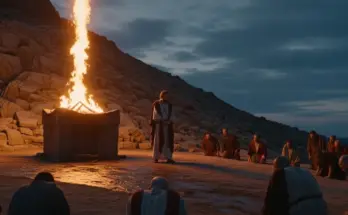
From Donkey-Seeker to Anointed King
The story of King Saul begins not in a throne room, but on the rugged hills of Benjamin. He was looking for donkeys.
Saul, the son of Kish, was from a wealthy and influential family (1 Samuel 9:1). The Bible describes him as a striking figure—tall, handsome, and physically impressive. “There was not a man among the people of Israel more handsome than he; from his shoulders upward he was taller than any of the people” (1 Samuel 9:2, ESV). Yet despite this commanding presence, Saul’s first appearance in the biblical record reveals a different kind of man—uncertain, even passive.
Sent by his father to search for lost donkeys, Saul roamed the land with his servant, covering territory from Ephraim to Shalisha and through the land of Zuph (1 Samuel 9:4–5). This journey leads him not to the animals, but to the prophet Samuel. At the servant’s suggestion, they visit the “seer,” a common title for a prophet in that era. Unbeknownst to Saul, God had already spoken to Samuel the day before: “Tomorrow about this time I will send to you a man from the land of Benjamin, and you shall anoint him to be prince over my people Israel” (1 Samuel 9:16).
This moment marks a pivotal intersection between divine providence and human uncertainty. Israel had demanded a king to be like the other nations (1 Samuel 8:5). Though their request grieved the prophet Samuel, and the Lord called it a rejection of His own kingship, He allowed it (1 Samuel 8:7). Saul’s selection was not random—it was intentional. God was granting the people’s request, but with a lesson built into the appointment.
Strong’s Exhaustive Concordance
The New Strong’s Expanded Exhaustive Concordance of the Bible is a valuable tool for pastors, teachers, and students of the Bible. This expanded edition is computer generated for highest accuracy, and the Hebrew and Greek dictionaries have been augmented with definitions from the classic reference work Vine’s Complete Expository Dictionary of Old and New Testament Words. Get Yours on Amazon
Samuel receives Saul as expected, and after a sacrificial meal and a private conversation, he anoints Saul with oil the next morning (1 Samuel 10:1). The prophet declares, “Has not the Lord anointed you to be prince over his people Israel?” This language is specific. The Hebrew term nagid (translated “prince”) carries a connotation of one who is appointed or designated to lead, not necessarily someone who already reigns with full authority. This subtly foreshadows that Saul’s authority, while God-given, would depend on his obedience to God’s will.
As Samuel sends King Saul on his way, he gives a series of signs to confirm the anointing. Among them is a striking transformation: “The Spirit of God will rush upon you, and you will prophesy with them and be turned into another man” (1 Samuel 10:6). When this prophecy is fulfilled, Saul joins a group of prophets and begins to speak under the influence of the Spirit of God. Those who knew him are stunned, asking, “Is Saul also among the prophets?” (1 Samuel 10:11). The phrase would become proverbial in Israel, marking the moment the Spirit visibly affirmed God’s call on this man’s life.
Yet even as God equipped him, Saul’s response was cautious. When the time came for the public announcement of Israel’s first king, the tribes were gathered at Mizpah, and lots were cast to reveal God’s choice (1 Samuel 10:20–21). As the lot falls on Saul, he is nowhere to be found. They inquire of the Lord, who reveals that Saul is hiding among the baggage (1 Samuel 10:22). This moment captures a powerful irony: the man chosen to lead Israel is found buried in the background, overwhelmed by the moment. Whether it was humility, fear, or insecurity—Saul’s reluctance to step into leadership would mark the first visible crack in his foundation.
Nevertheless, when King Saul stands before the people, he looks the part. “There is none like him among all the people,” Samuel proclaims. And the people respond with a shout: “Long live the king!” (1 Samuel 10:24). But not all are convinced. Some “worthless fellows” question his fitness to lead and offer him no honor. Saul, however, remains silent (1 Samuel 10:27), perhaps out of restraint, perhaps out of doubt.
This beginning is full of paradoxes. King Saul is chosen by God, empowered by the Spirit, and embraced by the nation—yet uncertainty and hesitation shadow his rise. His external appearance and initial spiritual experiences do not erase the deeper internal struggles. The man who was “turned into another man” by the Spirit is still very much wrestling with the man he was before.
From a historical lens, Saul’s ascension marks a transitional moment in Israel’s identity. They are moving from tribal confederation to monarchy—something no neighboring nation would have seen as revolutionary. But in the biblical context, this shift is profound. It represents not only a change in political structure but a test of covenant loyalty. Would Israel—and its king—submit to the rule of God even while holding the crown?
The story of King Saul begins not with rebellion, but with reluctant obedience. His journey opens with divine mercy and national hope. But the seeds of tragedy are already present—hidden not in his circumstances, but in his heart.
When Obedience Becomes Optional
The true breaking point in Saul’s kingship did not come with a spear or a scandal—it came with a sacrifice.
From the outside, King Saul still looked every bit the king. His victory over the Ammonites early in his reign had secured popular support (1 Samuel 11). He was now confirmed as ruler, and his authority appeared intact. But the testing of a leader rarely comes through applause. It comes when obedience and pressure collide. For Saul, that collision happened at Gilgal.
In 1 Samuel 13, Israel finds itself under threat from the Philistines, who assemble a massive army at Michmash. The people of Israel, frightened and vastly outnumbered, begin deserting Saul. Samuel, the prophet-priest who had anointed King Saul, had instructed him to wait seven days at Gilgal for his arrival to offer the proper sacrifices. But as the deadline approached and his army scattered, Saul’s fear overcame his instruction. He took matters into his own hands.
“So I forced myself, and offered the burnt offering,” Saul tells Samuel when the prophet finally arrives (1 Samuel 13:12, ESV). That phrase—”I forced myself“—is telling. It reflects not just a panicked decision, but a self-justifying spirit. Saul’s disobedience was not accidental. It was calculated under pressure. The command was clear. The timing was firm. And yet, Saul chose what seemed expedient rather than what was commanded.
Samuel’s response was swift and sobering: “You have done foolishly. You have not kept the command of the Lord your God… your kingdom shall not continue” (1 Samuel 13:13–14). Though Saul would still sit on the throne for years, the divine decision was final. God had already begun seeking “a man after his own heart.” Obedience, not offerings, was the measure of a king’s worth before God.
This first breach of obedience exposed a flaw in Saul that would deepen with time. He feared losing the people’s confidence more than he feared losing God’s favor.
That pattern becomes painfully clear in 1 Samuel 15—the defining failure of Saul’s reign.
God’s command, delivered through Samuel, was unmistakable: “Strike Amalek and devote to destruction all that they have” (1 Samuel 15:3). The Amalekites were not just enemies of Israel—they were ancient aggressors. They had ambushed the Israelites during their wilderness journey after the Exodus (Exodus 17:8–16). In Deuteronomy 25:17–19, God commanded their remembrance and eventual judgment. This mission was a divine reckoning—not a political conquest, but an act of justice.

Yet Saul again compromised. He defeated the Amalekites in battle but spared Agag, their king, and kept the best of the livestock. The rationale? “To sacrifice to the Lord your God” (1 Samuel 15:15). When Samuel arrives, the scene is almost tragicomic. Saul greets him with spiritual language: “Blessed be you to the Lord; I have performed the commandment of the Lord.” But the sound of bleating sheep betrays the truth.
Samuel’s rebuke pierces through the deception: “To obey is better than sacrifice, and to listen than the fat of rams” (1 Samuel 15:22). This moment is more than a correction—it is a divine judgment. Saul’s half-hearted obedience is framed as rebellion and arrogance. In Hebrew thought, rebellion (meri) was not merely disobedience but a high-handed rejection of God’s authority. And arrogance, the elevation of self-will over divine will, was likened to idolatry.
Saul’s response reveals his motive: “I have sinned… because I feared the people and obeyed their voice” (1 Samuel 15:24). The king chosen to lead Israel confesses that he was led by the people instead. His authority crumbled under the weight of popularity.
Though King Saul begs for forgiveness and pleads for Samuel to return with him, the verdict remains: “The Lord has torn the kingdom of Israel from you this day” (1 Samuel 15:28). The prophet turns to leave. Saul, in desperation, grabs his robe and tears it—an image mirrored in Samuel’s declaration of God tearing the kingdom from Saul.
From this point forward, Samuel never visits Saul again (1 Samuel 15:35). The man who had anointed him now walks away in grief. And the Spirit of the Lord departs from Saul soon after (1 Samuel 16:14), signaling a spiritual fracture that no ritual or remorse could repair.
The deeper tragedy is not in Saul’s mistakes—it’s in his excuses. He never wholly denied God. He continued religious practices. But he treated God’s commands as suggestions. In his world, obedience could be adjusted if the situation seemed to require it.
From a theological standpoint, Oneness Apostolic interpretation often sees Saul’s decline not just as disobedience, but as a warning: outward signs of calling do not guarantee continued favor. The anointing may rest for a time, but without obedience, it lifts. God’s presence will not remain where His voice is ignored.
Culturally, Saul’s compromise reflected a leadership model common in the Ancient Near East—kings made political calculations to ensure stability. But Israel’s king was to be different. He was to rule under God, not above Him.
The visible consequence was loss of dynasty. The deeper cost was loss of God’s voice. The divine silence that would follow became louder than any battlefield trumpet.
King Saul: A Tormented Soul in a Dimly Lit Palace
The moment the Spirit of the LORD departed from Saul, everything changed.
1 Samuel 16:14 records it with solemn brevity: “Now the Spirit of the Lord departed from Saul, and a harmful spirit from the Lord tormented him.” This chilling verse marks the spiritual unraveling of Israel’s first king. No longer empowered by the divine presence that once transformed him into “another man” (1 Samuel 10:6), Saul becomes the hollow shell of a ruler—troubled, erratic, and increasingly violent.
The consequences of his disobedience weren’t immediate removal from the throne but an invisible withdrawal of divine favor. In the ancient world, particularly within the Hebrew worldview, the Spirit of God represented empowerment, guidance, and legitimacy for leadership. Without it, Saul still wore the crown, but the kingdom had already begun to slip from his hands.
What follows is the introduction of David—not yet as a warrior or king, but as a servant with a harp.
Saul’s attendants, witnessing his emotional and mental torment, suggest a solution rooted in music: “Seek out a man who is skillful in playing the lyre, and when the harmful spirit from God is upon you, he will play it, and you will be well” (1 Samuel 16:16). David, the son of Jesse from Bethlehem, is recommended as not only a talented musician but also “a man of valor, a man of war, prudent in speech, and a man of good presence, and the Lord is with him” (v. 18).

NIV Study Bible Hardcover
With its decades-long legacy of helping readers grasp the Bible’s meaning, the NIV Study Bible embodies the mission of the NIV translation to be an accurate, readable, and clear guide into Scripture. Specifically designed to expand upon the NIV, the NIV Study Bible’s editorial team crafts that same accuracy and clarity into every study note. Get Yours on Amazon
David’s entry into Saul’s life is subtle yet providential. When he plays, the troubled king finds relief: “Saul was refreshed and was well, and the harmful spirit departed from him” (1 Samuel 16:23). This role, though seemingly minor, places David in the king’s court—at the very center of the kingdom he has secretly been anointed to inherit (1 Samuel 16:1–13).
But the tension between Saul and David escalates quickly.
After David’s dramatic victory over Goliath in 1 Samuel 17—a moment that electrifies Israel and confirms God’s hand upon the young shepherd—David’s popularity surges. Women sing in the streets, “Saul has struck down his thousands, and David his ten thousands” (1 Samuel 18:7). What may have seemed like a patriotic chant becomes a bitter thorn in Saul’s heart.
Jealousy takes root. Scripture records Saul’s inward shift: “And Saul eyed David from that day on” (1 Samuel 18:9). It is a loaded phrase. The Hebrew suggests suspicion, vigilance—perhaps even a sense of dread. Saul senses that the divine favor that once rested on him now rests on David. The once-relieving music of the lyre becomes a source of paranoia.
The spear becomes Saul’s new instrument.
Twice in 1 Samuel 18, while David plays, Saul hurls his spear at him, attempting to pin him to the wall. David escapes both times. Saul, tormented and afraid, recognizes that “the Lord was with David but had departed from Saul” (1 Samuel 18:12). The contrast between them could not be starker—one man rising under the weight of divine favor, the other collapsing under the silence of God.
Saul’s fear is more than political—it is spiritual. The phrase “Saul was afraid of David” appears repeatedly (1 Samuel 18:12, 15, 29). He tries every possible method to rid himself of David: assigning him to dangerous military posts, manipulating him with promises of marriage, even making him a commander in hopes he will fall in battle. But each attempt only increases David’s success and the people’s love for him.
The psychological portrait of Saul becomes clearer as his reign progresses. He is not merely insecure; he is unraveling under divine abandonment. In the ancient Israelite context, the king was to rule under God’s authority—his obedience, humility, and dependence on God were vital. Saul’s departure from those foundations left him exposed. Without the Spirit, without prophetic guidance, and without peace, Saul became consumed by envy.
From a theological standpoint, this moment serves as a warning: the absence of God’s Spirit is not neutral. It leaves room for torment, distortion, and fear to enter. While the harmful spirit is said to come “from the Lord,” this reflects an ancient understanding of God’s sovereignty—that even what is permitted to afflict comes under His control. Some scholars interpret this not as direct causation but as divine judgment: because Saul rejected God’s word, God allowed him to be tormented by the consequences of his disobedience.
Historically, the setting of Saul’s palace would not have been an opulent fortress, but a functional, royal encampment or structure, likely in Gibeah. His court would have been a mix of tribal warriors, advisors, and servants—many of whom would have witnessed firsthand his increasing instability. David, who once brought peace to the atmosphere, now walks cautiously in the shadow of a man unraveling.
The dimly lit palace had become a place of spiritual darkness.
The Sword That Fell on Its Master
The final chapter of Saul’s life is not marked by redemption or recovery. It is marked by silence—God’s silence—and the slow collapse of a man once chosen.
The Philistines had gathered for war once again, and this time they came in force. Saul, now aged and increasingly isolated, could not find peace or guidance. As the Philistine army encamped at Shunem, the sight of their numbers filled him with dread. “When Saul saw the army of the Philistines, he was afraid, and his heart trembled greatly” (1 Samuel 28:5). But the most devastating blow was not from the enemy. It was from heaven: “When Saul inquired of the Lord, the Lord did not answer him, either by dreams, or by Urim, or by prophets” (v. 6).
The silence was final. God, who had once filled King Saul with His Spirit and spoken through Samuel, now gave no reply. Every avenue of divine communication was closed. In desperation, Saul turned to what he had once outlawed: the occult.
He disguised himself and sought out a medium at Endor, violating God’s clear command in the Law (Deuteronomy 18:10–12). Saul had once banished such practices from the land (1 Samuel 28:3), yet now he crossed the very line he had drawn. This turning point reveals the depth of Saul’s spiritual collapse—not just his fear of defeat, but his willingness to pursue forbidden guidance when the living God remained silent.
The medium, terrified when she realizes her client is the king himself, is compelled to summon a spirit—an act Scripture neither condones nor treats lightly. What follows is one of the most mysterious scenes in the Old Testament. The spirit that appears is described as Samuel, and his message is anything but comforting: “The Lord has turned from you and become your enemy… Tomorrow you and your sons shall be with me” (1 Samuel 28:16, 19).
While scholars differ on whether this was truly Samuel or a permitted manifestation allowed by God for judgment, the message itself is consistent with Samuel’s earlier prophecies. There is no ambiguity: Saul’s time is over. The battle is already lost.
What follows is swift and tragic.
The Philistines strike hard against Israel on Mount Gilboa. Saul’s sons—Jonathan, Abinadab, and Malchi-shua—fall in battle (1 Samuel 31:2). With his line cut down before his eyes and the enemy closing in, Saul is wounded by archers. Fearing capture, humiliation, and abuse at the hands of the Philistines, he pleads with his armor-bearer to kill him. The man refuses. So Saul falls on his own sword (v. 4).
The one who once held the sword of Israel now dies by his own blade.
The aftermath is brutal. The Philistines desecrate the bodies of Saul and his sons, displaying them on the walls of Beth-shan. They strip Saul’s armor and place it in the temple of their gods—an act of mockery and false triumph (v. 9–10). This desecration was more than insult; it was a statement of theological dominance in the ancient world. By exposing Saul’s body and dedicating his armor to their deities, the Philistines claimed victory not just over a man, but over the God he represented.
But the men of Jabesh-Gilead remembered. Years earlier, Saul had delivered them from the Ammonites in one of his earliest acts as king (1 Samuel 11). Now, with courage and loyalty, they risk their lives, traveling overnight to retrieve the bodies and give them a proper burial (1 Samuel 31:11–13). It was a final act of honor for a king who had lost everything but was not forgotten.
Saul’s death marks the end of an era and the beginning of another. Though he ruled for forty years (Acts 13:21), his reign is remembered not for its victories, but for its decline. The crown that had been given in hope was surrendered in shame.
From a cultural standpoint, Saul’s suicide was not seen as noble. It was desperate. In the context of ancient Israel, taking one’s own life was not commended. Yet it reflected his final recognition: the kingdom was lost, and so was his place in it.
From a theological perspective, particularly within Oneness Apostolic circles, Saul’s life is often viewed as a cautionary tale—anointed but unsubmitted. Empowered by the Spirit but unwilling to stay under the authority of God’s Word. His fall was not sudden. It was a long descent into self-reliance, fear, and disobedience.
The sword that fell on King Saul was not just a weapon—it was the symbol of a life that could not be rescued by title, position, or appearances. He had led battles, built armies, and worn the crown. But he could not overcome the enemies within: fear of man, unwillingness to obey, and the refusal to fully yield to God.
Discover More Untold Stories
We hope this untold story helps you see God’s work in a new way. You can keep exploring by visiting our homepage at BibleStudyToolbox.com. You can also browse more articles in the Untold Stories category to continue your study. If you have any questions or want to reach out, please visit our Contact Page.